|
Based on content by Bob Eager (original HERE) and Peter H. Wendt (HERE). Edited by Major Tom.
All PS/2s use a battery of some kind to power the CMOS memory that holds the
system configuration information, and to run the Real Time Clock (RTC). This
page lists the different kinds of batteries in use and what their modern
alternatives are. Provided are also some tips on removing and reinstalling the
battery.
Cross-reference of individual PS/2 Models and the corresponding battery
types. Click on the FRU number for more information on that particular
item:
FRU 33F8354 - 3 V Coin Cell Battery
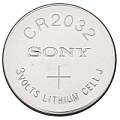
This is a conventional 3 V lithium coin cell battery (20 mm x 3.2 mm).
Equivalents are:
| Duracell |
Eveready |
Panasonic Varta Sony Sanyo
Rayovac Maxell Toshiba |
AWI |
NEDA |
Other |
| DL2032 |
ECR2032 |
CR2032 |
L14 |
5004LC |
EA-2032C |
Battery Voltage and Life Expectancy
The battery used on the 95xx products has a normal life expectancy of five
to seven years. The life of the battery is directly related to how the machine
is used. Battery voltage is consumed only when the system is powered off. Since
the battery is a lithium battery, it has very long shelf life. For correct
machine operation the battery voltage should be between 2.5 volts and 3.7
volts.
Note: Low voltages can corrupt CMOS bits.
To check the battery voltage:
- Turn off the system unit power.
- Remove the battery from the battery holder.
- Check the battery for a voltage of 2.5 - 3.7 V DC
If the battery voltage drops below 2.5 volts, it should be replaced with FRU
P/N 33F8354 (CR2032). After replacing the battery, the system unit should be
powered on and checked for proper operation.
FRU 64F9987 - Dual Coin Cell Battery Pack
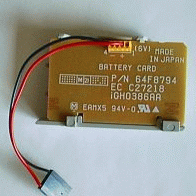 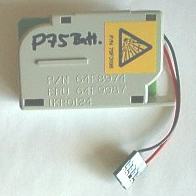
This consists of two conventional coin-shaped 3 volt lithium cells soldered
to a small circuit board, attached to a 5cm red & black cable with a
battery connector at the other end. A plastic hood covers the two cells.
Currently, there is no known direct equivalent.
The lithium cells are 3 volt coin cells with two solder tags on one side.
Equivalents are:
| Panasonic |
Sony |
| CR2477 |
CR2477 |
These cells are not as easy to find as any of the others listed here; places
to try include:
An alternate approach is to use an AT-style battery pack, or anything else
that will fit inside the case! AT replacement battery packs are rated at 6.0
volts, and generally contain a resistor which prevents charging and controls
the voltage. They come with attached wires, a 4 pin connector and velcro mount,
and fit nicely in the battery/speaker cavity. The velcro can be used to attach
it to the bottom surface so that it doesn't move. The header pinout is correct,
and even has the plug in the second hole to correctly polarize the header.
One source is the BR-E3-BP, from
Batteries Plus.
FRU 72X8498 - 6 V Lithium Battery Pack
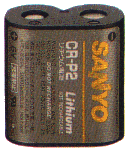
This is a 6 volt two-cell lithium pack. The original IBM ones are usually
yellow, with black ends. Replacements are available as camera batteries.
Equivalents are:
| Varta Panasonic GP Sony Sanyo |
Duracell |
Ever Ready |
Kodak |
Ray-O-Vac |
| CR-P2 |
DL223A |
EL223AP |
K223LA |
PC223 |
FRU 8509237 - Dallas RTC/CMOS Module
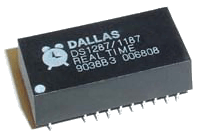
This is the infamous self-contained Dallas CMOS RAM module with an
integrated RTC/CMOS chip and battery. The entire module must be replaced. The
Dallas part number is DS1287, but this part is now obsolete. According to the
Dallas Semiconductor data book, the DS1287 can be replaced by the DS12887 (the
latter is pin compatible but has more RAM).
The DS12887 is not Year 2000 compliant, but of course PS/2s are compliant
except that a manual reset of the date is required at the start of the year
2000. Do not be tempted to use the Year 2000 compliant upgrade to the
DS12887, which is designated the DS12C887; it uses the century byte differently
to a PS/2 and will apparently not work.
The DS1287 can also be replaced by the DS1287A, and the DS12887 by the
DS12887A; the only difference in each case is that the part with the 'A' suffix
has a pin which can be used to clear the RAM; this pin is unused on PS/2s.
There is also a way to Rework the DS1287
(by attaching an external battery to the RTC module).
Some useful info about DS1287 and other RTC modules can be found
HERE.
Equivalents are:
| Dallas |
Odin |
BenchMarq |
| DS12887 |
OEC12C887 |
BQ3287MT |
| DS12887A |
OEC12887A |
BQ3287AMT |
PS/2 Models 50, 60, 70, P70, or 80
The battery is held in a special Battery/Speaker Assembly.
Battery in your machine is dead, configuration is lost after relatively
short time again and you get the error-codes 161, 162/163. Or the internal
clock will not display the correct date and time after the system was powered
off for some time. (Hence: this is not necessarily a battery problem.) You
try to get a PS/2 battery FRU 72X8498 for your system.
And pay about 40$ (or 60 DM in Germany) for this.
Isn't there any cheaper solution?
Yes - it is. Go to your local photo-shop. Have your old battery with you and
look for something labeled 'CR-P2', or 'BR-P2' (different manufacturer,
different numbers sometimes), either from Panasonic, Varta, Sony or DL223A from
Duracell... or any other. All are 6 V Lithium batteries. Compare the two.
Appears to be the same. Compare the price. Wow! Only a few dollars (or 26 DM
here).
Take one of these batteries and leave the old one in the shop for recycling.
Problem solved.
PS/2 Models 25 SX, 56, 57, 76, 77, 85, 90, 95, or PS/2 E
These models use a round button-type Lithium cell FRU 33F8354
which is in fact a CR-2032. Easy to guess that these things are much cheaper
in a department-store than supplied as a spare-part from IBM.
Same tip as above: remove it from your computer, go to a department store
(photo-shop / watches department), buy one with the same number or a compatible
and leave the old one in the shop for recycling.
PS/2 Models 25 and 30 (8086)
The model 30-0xx has a 3 V battery on the riser-card (slot card) and it is
soldered. If you are a bit experienced with a soldering iron and a multimeter,
you will sure find + and - of the battery, unsolder it and install one of the
cheap battery holders for 2 resp. 4 pieces of AA (Mignon) batteries. These
holders come with a red wire for + and a black wire for -, are made of plastic
and you could use some velcro-tape to put them i.e. at the rear of the unit or
somewhere else. Make sure, that the terminals on the battery holder are
insulated with tape and cannot contact metal surfaces or internal parts.
Use 2 resp. 4 high quality 1.5 V AA-style batteries (i.e. Duracell, Philips
or Ucar) and this construction will do until the year 2001 - or even longer.
Don't use too cheap batteries. The relatively high internal temperature of a PC
might lead to defective cells, these run out, cause a big mess and probably
damage the planar.
You can use batteries, because - unlike to some Taiwan-boards - the CMOS/RTC
battery is a real 'battery', no accumulator. It will neither be charged during
power on nor will be any kind of 'refresh-current' be applied on it. That makes
everything very easy.
PS/2 Models 25-286, 30-286, 35, 40, 55 SX, 65 SX
These units use so-called "clock-modules" - which is an IC-style circuit
(black box from Dallas Semiconductor) with a lithium battery molded inside.
These can only be replaced as a complete part.
All the above mentioned
machines use a clock-module FRU 8509237 which is Dallas
DS1287.
The DS1287 chip can be substituted by its successor DS12887 - which is pin-
and function-compatible. And there is a way to
Rework the DS1287 with an external battery
when the internal cell died ... not for the faint at heart and it requires some
tools, solder capabilities and some more parts.
|